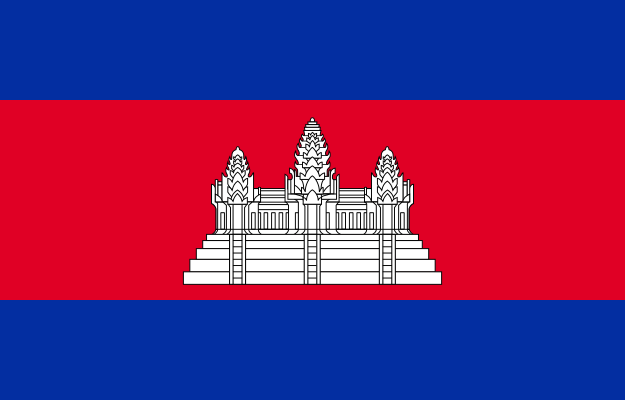
Victory over Genocide Day in Cambodia
Victory over Genocide Day in Cambodia is a solemn national holiday observed every year on January 7th. This day marks a significant moment in Cambodia's history, commemorating the end of the Khmer Rouge regime in 1979. The Khmer Rouge, led by Pol Pot, was responsible for one of the most brutal genocides of the 20th century, during which an estimated two million Cambodians lost their lives due to starvation, forced labor, and execution. The holiday serves as a day of remembrance for those who perished, as well as a celebration of the resilience and unity of the Cambodian people who survived this dark period.
The liberation of Phnom Penh and the fall of the Khmer Rouge on January 7, 1979, by the Vietnamese armed forces, in collaboration with the Cambodian United Front for National Salvation, is seen as a turning point in Cambodian history. It brought an end to four years of terror and suffering. Victory over Genocide Day is therefore not only a day to remember the victims but also to recognize the courage and solidarity of those who fought for Cambodia's freedom from tyranny.
The Importance of Victory over Genocide Day
Victory over Genocide Day holds profound importance for Cambodians, serving as a reminder of their country's turbulent past and the tremendous cost of peace and freedom. It's a day for the nation to come together to honor the memory of those who died under the Khmer Rouge regime and to reflect on the importance of human rights and justice. Ceremonies and memorials take place across the country, with government officials, dignitaries, and citizens paying their respects to the victims through offerings, prayers, and moments of silence.
This day also serves an educational purpose, teaching younger generations about the atrocities committed during this period and the importance of peace and stability. By remembering the past, Cambodia aims to ensure that such a tragedy never happens again. The day underscores the value of life, liberty, and the human spirit's endurance in the face of unimaginable hardship.
Observances and Commemorations
Victory over Genocide Day is observed with various ceremonies and activities designed to honor the past while looking forward to the future. In Phnom Penh, the capital city of Cambodia, official ceremonies are held with speeches by government leaders, military parades, and tributes at monuments dedicated to the victims of the genocide. One of the key sites of commemoration is the Choeung Ek Genocidal Center, also known as the Killing Fields, where thousands were executed and buried in mass graves.
Throughout the country, communities gather to participate in remembrance activities, including lighting candles, laying wreaths, and offering prayers at local temples. Educational programs and exhibitions are also organized to inform the public about the history of the Khmer Rouge period, emphasizing the need for reconciliation and healing.
The Role of Victory over Genocide Day in Healing and Reconciliation
Victory over Genocide Day plays a crucial role in the healing and reconciliation process for Cambodia. By officially recognizing the suffering endured by its citizens, the government and people of Cambodia take a collective step towards healing the wounds of the past. The day encourages a dialogue about the genocide, allowing survivors to share their stories and experiences. This open acknowledgment is vital for the nation's emotional and psychological recovery, fostering a sense of closure for many.
Furthermore, the day emphasizes the importance of justice and accountability. Over the years, efforts have been made to bring Khmer Rouge leaders to trial for their crimes against humanity. The holiday serves as a reminder of the ongoing need to uphold the rule of law and protect human rights to prevent future atrocities.
Victory over Genocide Day in Cambodia is a poignant reminder of the country's struggle and resilience in the face of horrific adversity. It honors the memory of those who were lost and celebrates the strength and unity of the Cambodian people. Through commemoration, education, and reflection, the day contributes to the nation's journey towards healing, reconciliation, and a future grounded in peace and justice.