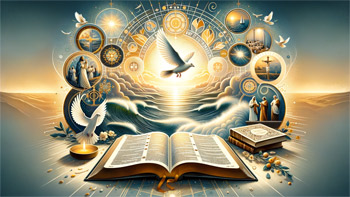

The New Testament is a collection of religious texts central to Christianity, believed to be written in the 1st century AD. It is the second major part of the Christian biblical canon, the first being the Old Testament, which is based primarily upon the Hebrew Bible. The New Testament lays the foundation for Christian theology and practice, detailing the life, teachings, death, and resurrection of Jesus Christ, as well as the spread of Christianity through the apostles.
Comprising 27 books written by various authors in Koine Greek, the New Testament includes narratives, letters, and apocalyptic writings. It begins with the four Gospels, which recount the life and teachings of Jesus. The Book of Acts describes the early Christian community and its expansion. The Epistles, letters written by early Christian leaders, address issues of Christian belief, ethics, and community life. The New Testament concludes with the Book of Revelation, a prophetic text about the end of the world and the coming of God's kingdom.
The Gospels
The Gospels of Matthew, Mark, Luke, and John are the first four books of the New Testament and are central to Christian faith. Each offers a unique perspective on Jesus' life, ministry, death, and resurrection. Matthew, Mark, and Luke are known as the Synoptic Gospels due to their similar viewpoints and shared material, while John presents a distinct narrative. These texts provide the most detailed accounts of Jesus' teachings, miracles, and interactions with people, emphasizing his significance as the Messiah and Son of God.
The Gospels serve not only as historical accounts but also as theological documents that explore the meaning of Jesus' life and work. They are used in Christian worship, teaching, and personal reflection, offering guidance and inspiration to believers.
The Acts of the Apostles
Following the Gospels, the Book of Acts, written by Luke, narrates the early history of the Christian church. It begins with Jesus' ascension into heaven and follows the apostles as they spread the message of Christianity from Jerusalem to the Roman Empire. Central figures such as Peter and Paul emerge as leaders in the Christian community, facing challenges, persecution, and miraculous events. Acts is a key source for understanding the early church's development, its missionary efforts, and the role of the Holy Spirit in guiding believers.
This book highlights the inclusivity of the Christian message, showing how it spread beyond Jewish communities to Gentiles, thereby establishing a universal faith open to all people.
The Epistles
The Epistles are letters written by early Christian leaders like Paul, James, Peter, John, and Jude to various churches or individuals. They address theological issues, moral guidance, and practical aspects of Christian living. The Epistles of Paul, including Romans, Corinthians, and Galatians, are some of the most influential, articulating key doctrines such as justification by faith, the role of Christ in salvation, and the nature of the Church.
These letters were circulated among early Christian communities and have been preserved as part of the New Testament canon. They continue to be vital for Christian theology, worship, and ethics, providing insight into the challenges and concerns of the first Christians.
The Book of Revelation
The New Testament concludes with the Book of Revelation, also known as the Apocalypse. Written by John, this prophetic text uses vivid imagery and symbolism to describe the end times, the final battle between good and evil, and the establishment of God's kingdom. Revelation has been the subject of much interpretation and speculation, offering hope to Christians facing persecution and suffering by promising God's ultimate victory over evil.
Despite its complex and often mysterious content, Revelation is a source of comfort and encouragement for believers, reminding them of God's sovereignty and the fulfillment of his promises.
The New Testament is not just a historical document but a living text that continues to inspire, challenge, and guide millions of people around the world. Its teachings on love, forgiveness, justice, and hope resonate across centuries, influencing art, literature, and culture. For Christians, the New Testament is the word of God, offering a path to salvation through faith in Jesus Christ and a blueprint for living a life aligned with God's will.
Throughout history, the New Testament has been translated into numerous languages and distributed globally, making it one of the most widely read and influential books ever written. Its message of redemption, combined with the ethical teachings of Jesus, has shaped the moral foundations of Western civilization and continues to impact discussions on morality, law, and human rights.
In conclusion, the New Testament remains a central and enduring source of spiritual guidance, theological reflection, and ethical instruction for Christians and many others around the world. Its narratives of Jesus' life and teachings, the early church's struggles and triumphs, and the hope of eternal life through faith in Christ continue to offer profound insights into the human condition and the possibility of redemption and transformation.